спецпроект theatrehd

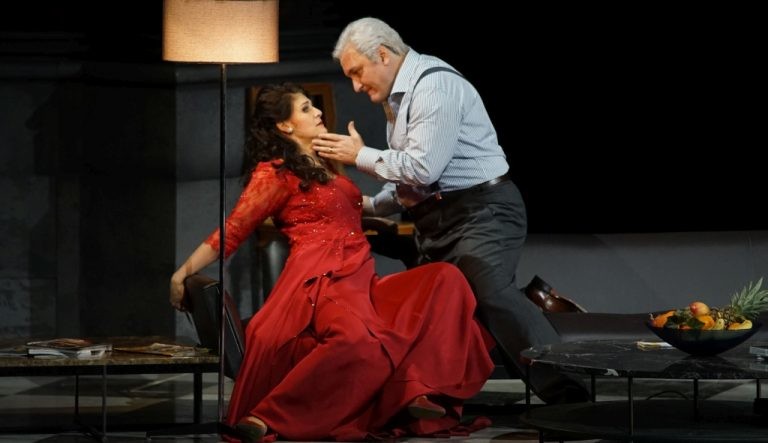
Mozart - Festkonzert from Salzburg
спецпроект theatrehd

Mozart - Festkonzert from Salzburg
The Salzburg Festival spreads wide in both time and space: it begins in spring with the Easter Festival, gathers momentum by Whitsun, and swells to a crescendo in the height of summer. The entire city becomes a venue: performances take place in squares, palaces, churches, theatres, and concert halls. On Cathedral Square, Hofmannsthal's "Jedermann" is performed every year; concerts are held at the Mozarteum and the Residenzhof; and operas and dramatic productions are staged at the State Theatre. On the site of the prince-archbishop's former stables and riding schools, three halls were built especially for the festival: the Großes Festspielhaus, the famous Felsenreitschule stage carved into the rock, and the Haus für Mozart.
For over a century, since 1920, opera, theatre productions, and concerts of the highest caliber have attracted world-class performers and audiences from around the globe to Salzburg. Furtwängler, Karajan, Abbado... The festival has always been led by the best of the best, those who never sought easy paths or solutions. As a result, its themes have always oscillated between cosmopolitanism and patriotism, enlightenment and conservatism. Ambivalence and thematic conflict have accompanied the festival throughout its long history. And to this day, it wavers between the tense poles of avant-garde and mainstream.
And experience has shown that this appeals to everyone: to the discerning, sophisticated audience, to the renowned musicians, and to the directors who draw inspiration from the unique atmosphere of Europe’s most famous festival city.
For over a century, since 1920, opera, theatre productions, and concerts of the highest caliber have attracted world-class performers and audiences from around the globe to Salzburg. Furtwängler, Karajan, Abbado... The festival has always been led by the best of the best, those who never sought easy paths or solutions. As a result, its themes have always oscillated between cosmopolitanism and patriotism, enlightenment and conservatism. Ambivalence and thematic conflict have accompanied the festival throughout its long history. And to this day, it wavers between the tense poles of avant-garde and mainstream.
And experience has shown that this appeals to everyone: to the discerning, sophisticated audience, to the renowned musicians, and to the directors who draw inspiration from the unique atmosphere of Europe’s most famous festival city.


Salzburg: Don Carlo
The Salzburg Festival hosts a new production of Verdi’s “Don Carlo”, directed by Peter Stein and embodied by Jonas Kaufmann.


Salzburg: La Traviata
This recording of Verdi’s "La Traviata" from the 2005 Salzburg Festival – the uncontested and hopelessly sold-out highlight of the festival season – captures the triumphal performance not only of Anna Netrebko as Violetta Valéry, but also of Rolando Villazón as her lover Alfredo.

Salzburg: L’Italiana in Algeri
Moshe Leiser’s & Patrice Caurier’s colourful production of "L’Italiana in Algeri" with Cecilia Bartoli in the title role and Ildar Abdrazakov as Mustafà. Conducted by Jean-Christophe Spinosi.